Tide
Spatial rummy, 2 to 4 players, in three formats
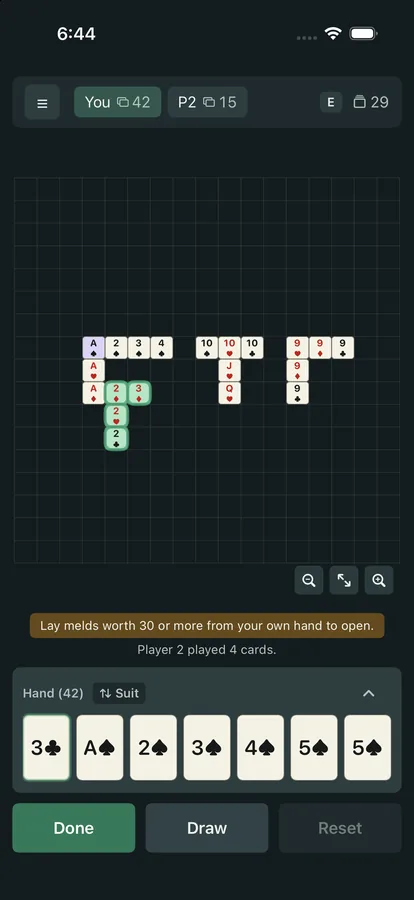
In Tide you can move anything on the table. Split melds up, recombine them, use a card someone else played, as long as it is all valid again when your turn ends. Melds sit as separate islands and can cross each other, sharing a card.
What you play with
- Two standard decks plus two jokers
- A 20 by 20 table
- Ace is low and worth 1. Jack is 11, queen 12, king 13
Melds
A meld is a whole unbroken line of cards read along one axis.
Runs
Three or more consecutive ranks in one suit, reading either direction. Ace is low only, so king, ace, two is not a run. Thirteen cards is the longest possible.
Sets
Three or four cards of one rank, every suit different. Two decks make it possible to try to repeat a suit, and that is rejected.
Jokers
At most one joker in a meld. A joker takes on whatever card its meld needs and carries that identity while it sits there. Free it by rearranging and it can become something else in the same turn. You are only asked which card it is when a set leaves more than one suit open.
What makes a table legal
At the end of every turn, all three of these have to be true:
- every card is on the board
- every line is either a single card or a finished meld, never a two card fragment
- every card belongs to at least one meld, going across or down
A card melded on neither axis is loose, and loose cards are not allowed. Unlike Anchor there is no requirement that everything connect up. Islands are fine.
Your turn
Do exactly one of these.
Rearrange
Submit the whole table as you want it to stand. The submission has to:
- keep every card that was already on the table, nothing goes back to a hand
- add at least one card from your own hand
- name every card truthfully, with only jokers given a declaration
- leave the table legal by the three rules above
Draw
Take the top card of the draw pile and end your turn.
Pass
Legal only once the draw pile is empty.
Opening
Until you have opened, you are fenced off from the table. You may lay only your own cards, into melds made entirely of your own cards, and you may not move or extend anything already out there. Those cards have to total at least 30 in face value, counting a declared joker as whatever it stands for.
Once you have opened, you can rearrange freely for the rest of the round.
Ending a round
A round ends when someone empties their hand, or when everyone passes in a row with the draw pile empty.
- Went out. The player who emptied their hand wins the round.
- Blocked. The player holding the smallest hand value wins it.
In Classic and Empty Hand, everyone else scores minus the face value of whatever is left in their hand, and a joker left in hand costs 30. The winner gets the sum of those penalties. Meld Score works differently, below.
Three ways to play
All three are the same game underneath. What changes is how a match is won. The grid runs through all of them: melds take up real squares, so the table fills, and where you lay something decides whether it can grow later.
Empty Hand
One round is the whole match. Whoever takes that round wins it.
Worth knowing: that includes a blocked round, where the smallest hand wins. Most rounds end blocked rather than with somebody going out, so this is the common case, not the edge case.
Classic
The traditional form. Rounds are settled by hand penalties and dealt again, to 200 points or five rounds, whichever comes first. Highest score wins. With two players nobody usually reaches 200 inside five rounds, so it comes down to who is ahead when the rounds run out.
Meld Score
Every meld scores as you lay it, the face value of the cards that came out of your hand. A joker scores nothing, or laying it as a king would be the best move available every single turn.
Extending a meld pays only for the cards you added, not for the meld you joined, and rearranging cards already on the table pays nothing, since neither left your hand. Rounds are not settled by hand value here, because those cards were already paid for on the way down. Going out still ends a round, which is what stops everyone else scoring further.
The target is 200, over at most six rounds. This is the only format that can end in the middle of a round: the match is over the moment someone reaches the target, not when that round happens to finish.
How it differs from Anchor
| Anchor | Tide | |
|---|---|---|
| Cards already played | Never move | May be moved and recombined |
| Unfinished melds | Allowed, up to a limit | Never, the table is always resolved |
| Aces | Anchors, worth 0 | Ordinary low card, worth 1 |
| Board must connect | Yes, except anchor plays | No, islands are fine |
| Winning | First to the target score | Depends on the format |