Anchor
Spatial rummy, 2 to 6 players
Anchor is played on a shared 15 by 15 board. You have 7 cards. You score by making runs and sets, and by extending ones that are already out. Nothing moves once it is down, so a bad placement stays bad.
What you play with
- Two standard 52 card decks plus four jokers, 108 cards in total
- A 15 by 15 board
- A draw pile and a three card discard market
- A hand of 7 cards, refilled at the end of your turn
What cards are worth
| Card | Value |
|---|---|
| 2 to 9 | Face value |
| 10, J, Q, K | 10 |
| Ace | 0 |
| Joker | 0 |
Aces are not low cards. An ace is never part of a run or a set. It exists only as an anchor. That means the lowest run is 2-3-4, and there is no such thing as a set of aces.
Melds
Runs
Same suit, consecutive, three to five cards. No wrapping around from king to ace.
Sets
Same rank, three or four cards, every one a different suit.
The board
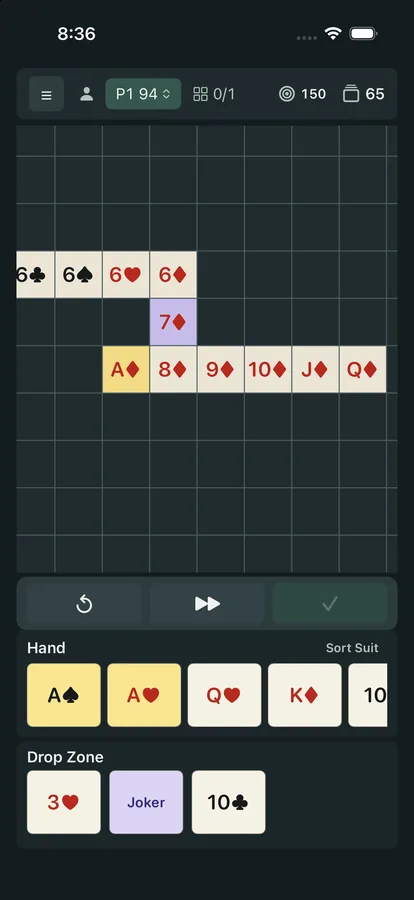
- Cards read across or down, never diagonally
- No stacking, and no gaps inside a line
- A card may belong to a run one way and a set the other way at the same time
The game starts with a single ace in the centre. That ace belongs to nobody and scores nothing. Every group you place has to connect to something already on the board, with exactly one exception, below.
How a line may end its turn
When your turn ends, every line you touched has to be one of three things:
- a single bare card, which is legal but is not a meld
- an open meld of two cards, which is legal but counted against a limit
- a complete meld
Anything else is an illegal move. How many open melds you may leave depends on the table:
| Players | Open melds allowed |
|---|---|
| 2 | 1 |
| 3 to 4 | 2 |
| 5 to 6 | 3 |
A line touching an anchor is stricter still. It must be a complete meld, always. A bare card or an open meld next to an anchor is never allowed, however legal it would be anywhere else.
Anchors
Playing an ace is the only way to start a new, separate island of cards somewhere else on the board. It costs your whole turn.
An anchor play is one line of four or five cards, placed together:
- exactly one ace, at one end of the line, never in the middle
- three or four other cards next to it, forming a complete run or set on their own
- none of them touching any card already on the board
The ace is not part of the meld. It does not count toward the line's length and it does not help complete anything, it just marks the cell. It scores zero. The meld next to it scores normally. So does anything anyone builds off that anchor later, including other players. Anchors are not owned.
Your turn
Choose exactly one of these.
Play
Place up to two groups of cards, or one anchor play. A group is one or more cards, contiguous, in a single row or column, connected to something already on the board. The two groups do not have to touch each other. An anchor play cannot be combined with anything else.
You do not have to finish a meld in one turn, within the open meld limit above. Draw back up to seven at the end.
Cycle
Discard one to three cards and draw the same number. It is an even swap and it either happens in full or not at all.
Pick
Take one to three cards from the discard market and discard the same number. No board play this turn.
Anchor exchange
Return one to three unwanted aces to the draw pile and draw the same number back.
Scoring
- Cards you play that end up in a complete meld score double their value
- Jokers score zero, anchors score zero
- Cards already on the board never score again
- Each card scores once, even if it sits in both a run and a set
Winning
When someone reaches the target, finish the round. Highest score wins.
| Players | Target |
|---|---|
| 2 | 150 |
| 3 to 4 | 250 |
| 5 to 6 | 300 |
Ties are broken by most completed melds, then longest completed run, and if it is still level, the win is shared.
Odds and ends
- Only the three most recently discarded cards stay available
- When the draw pile runs out, the older discards are shuffled into a new one
- If you have no legal move, pass. If everyone passes in a row, the game ends