Line
Spatial rummy, 2 to 4 players
Everyone builds one shared 4 by 4 grid. Sixteen squares, and nobody can take them apart. When the grid fills, whoever is holding the least wins.
Only rows are melds. Columns are just positions. A card sitting above another card has nothing to do with it.
What you play with
- One standard deck plus 4 jokers, 56 cards
- A 4 by 4 grid, a draw pile and a face-up discard
- A hand of 7 cards
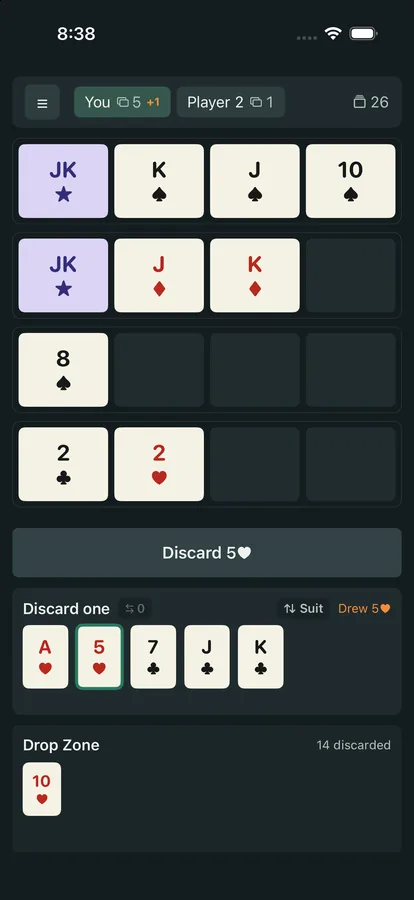
Rows
Every row has to be able to end up as one of two things.
Run
Four consecutive cards of one suit. Ace is low, so A-2-3-4 is the lowest and 10-J-Q-K is the highest. No wrapping around.
Set
Four cards of one rank, one of each suit.
Where you put a card inside its row makes no difference to whether it is legal. The app arranges rows tidily for reading, runs ascending and sets in suit order, but the rule does not care.
Placing a card
You can put a card in an empty square only if that row can still finish.
- The first card in a row can be anything
- The second real card decides the row. Same rank makes it a set, same suit makes it a run, anything else is illegal
- Once a row has a type, everything after has to agree with it
Jokers
- One joker per row, at most
- A joker is never declared. It stands for whatever single card the row needs, and that can change as the row changes
- A row with a joker is legal as long as there is some card the joker could be that lets the row finish
- One joker covers one gap. It cannot fill two
A joker on its own does not decide anything. A row holding a joker and one real card is still undecided between a run and a set until a second real card settles it.
Your turn
Play one card from your hand, or do an upgrade, or do a shift.
If none of those three is possible, then and only then you take the top discard, if it can go straight down, or you draw. A drawn card you can play goes down at once. A drawn card you cannot play joins your hand and you discard back to seven.
If you have to draw and the pile is empty, the game is over.
You cannot skip a move you can make in order to draw instead. That covers playing a card from your hand, and shifting into a finished run. An upgrade and an eject from an unfinished row are offered rather than forced, because either can cost you more than the draw would.
Finishing a row
Complete a row and you get one extra turn straight away. Complete another on that extra turn and you get nothing more. Bonus turns never chain.
If the placement that completes a row also fills the last square on the grid, the game ends there and the bonus turn is never played.
Upgrade
Swap a joker out of a completed row for a real card from your hand that keeps the row valid. That is your whole turn.
- The row has to be full. A joker in a half-built row cannot be upgraded
- The freed joker has to go somewhere immediately, either into another legal empty square or into your hand
- One joker per row still applies wherever it lands
- You only get a bonus turn if the joker's new position completes a row
Often more than one card would do. A row of 6♠ 7♠ 8♠ and a joker will take either the 5♠ or the 9♠. The rule only asks whether your card keeps the row valid.
Shift
Instead of playing into an empty square, play a card into a completed run and push one card off the end. Sets never shift.
The row has to still be a valid run once exactly one card has come out. Whatever is pushed off goes face up on the discard, joker or not.
The card you played stays in the row, and the card that leaves has to be one of the four that were already there. You cannot push out the card you just played, which would leave the row untouched and turn shift into a free discard.
The card you play has to be a real card. A joker cannot be played into a shift, or you could move twenty points out of your hand for nothing. Where more than one card could legally be pushed off, you choose which.
Ejecting from a row still being built
A row locks its shape as soon as its second real card lands, and it can lock onto cards that are already somewhere else on the grid. Those squares can then never be filled. So you can also play into an unfinished row and push one card out of it.
- The row has to hold at least two cards already
- Your card has to be one that could not simply join the row as it stands
- What is left has to be a legal row, not a finished one
- The ejected card goes to the discard and you draw a replacement straight away
- Two of these per player per game
- Not offered once the draw pile is empty, since there is nothing to draw back
Eject the K♣ from K♣ Q♣, play a Q♥, and a club run that nobody can finish becomes a set of queens. A shift into a finished run is not capped and never has been; only this one spends from the two.
Ending and scoring
The game ends the moment the grid fills, or when someone has to draw and the pile is empty.
Count what is left in your hand. Lowest total wins.
| Card | Value |
|---|---|
| Ace | 1 |
| 2 to 10 | Face value |
| J, Q, K | 10 |
| Joker | 20 |
Hand melds. Cards left in your hand that make a run of three or more in one suit, or a set of three or more of one rank, score 0. A card counts in one meld only, and jokers never take part. A joker is 20 wherever it ends up. The app works out the arrangement that scores you lowest, so you cannot lose to having missed your own best grouping.
Ties go to whoever holds fewest cards. Still tied, the win is shared. That tiebreak counts cards rather than points, so a card a hand meld scored at zero still counts against you there.
How it differs from the other two
| Anchor | Tide | Line | |
|---|---|---|---|
| Board | 15 by 15, grows outward | 20 by 20, rebuilt freely | 4 by 4, fixed |
| Melds read | Both directions | Both directions | Rows only |
| Meld length | 3 to 5 | 3 to 13 | Always 4 |
| Cards already down | Never move | Move freely | Only via shift |
| Winning | Highest score | Depends on the format | Holding the least |